
Laundry changes when several people share a home. One load of clothing is followed by school uniforms, towels, sports gear or bedding, and the clothesline may barely be empty before it is needed again. In that situation, choosing a line based purely on its dimensions can be a mistake.
A family needs enough drying capacity, but it also needs a setup that is comfortable to use repeatedly. Position, accessibility and the types of items normally washed can matter just as much as total line length.
Count a Real Week of Laundry
Before comparing clotheslines, keep track of washing for one ordinary week. There is no need for a complicated list. Simply notice how many loads are washed and which ones occupy the most drying space.
A household with young children may wash smaller items frequently, while teenagers involved in sport can generate bulky clothing and towels. Bedding creates another challenge because a few sheets can occupy a large part of the line.
This gives a much more useful estimate of required capacity than planning around an unusually busy washing day.
Do Not Assume Bigger Means Better
Searching for the best clothesline Australia can encourage shoppers to compare capacity first. Yet the largest model is not automatically the most useful.
An oversized clothesline can consume valuable backyard or courtyard space throughout the week. If much of that capacity is rarely used, the household has sacrificed outdoor room for little practical benefit.
Aim for enough space to handle normal busy periods comfortably. Occasional unusually large loads can often be split rather than designing the entire outdoor area around them.
Make Everyday Access Easy
When washing happens frequently, even a slightly inconvenient clothesline position becomes annoying.
Consider the journey from the washing machine. Carrying a heavy basket down steps, through a narrow gate or around outdoor furniture several times a week adds unnecessary effort. A convenient position may be worth more than a distant location that receives slightly longer sunshine.
Leave enough room beside the line for the basket as well. Hanging clothes is easier when there is space to move instead of constantly stepping around obstacles.
Consider a Dedicated Ground Position
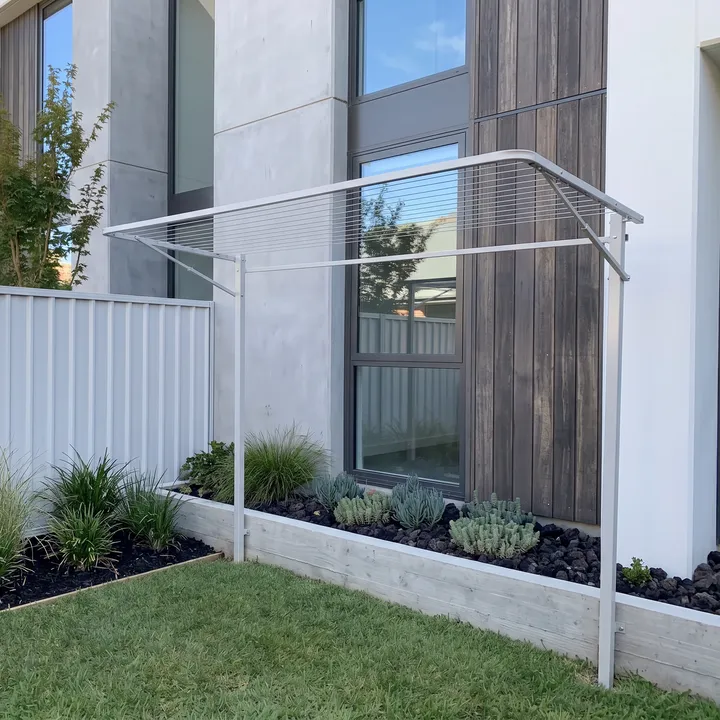
For households with suitable outdoor space, a freestanding washing line can create a defined drying area without relying on an available wall.
Placement still needs thought. A ground-mounted setup should not interrupt the main path through the yard or sit where children regularly play. It also needs suitable installation according to the product requirements and conditions at the property.
Marking the approximate footprint before installation can help the family see how the structure will affect the yard.
Check Whether Large Items Hang Comfortably
Family laundry usually includes more than shirts and shorts. Towels, sheets and quilt covers need enough room to hang without dragging against the ground, garden beds or nearby objects.
Line spacing matters here. Packing too many bulky items closely together can make the available capacity less useful than expected.
Think about height too. The person who handles most of the laundry should be able to reach the lines comfortably. A setup that requires constant stretching can become tiring when used almost every day.
Give Wet-Weather Laundry Somewhere to Go
A busy family cannot always wait several days for clear weather. Uniforms and work clothes may be needed again quickly.
Having a modest backup drying option can prevent a rainy week from disrupting the routine. It might be a covered area or a suitable portable line used indoors with adequate ventilation.
The backup does not need enough space for every sheet in the house. It simply needs to handle priority clothing until outdoor conditions improve.
Think About Maintenance Before It Becomes a Chore
Frequent use means the clothesline will be opened, loaded and handled regularly. Check components periodically and follow the manufacturer’s care guidance.
Keeping the surrounding area clear can help too. Overgrown plants, accumulated dirt or stored objects around the base can make a perfectly good drying area unpleasant to use.
Small amounts of routine attention are easier than dealing with several problems at once later.
Conclusion
For a busy household, the real test of a clothesline happens on an ordinary Tuesday when uniforms, towels and yesterday’s washing all need somewhere to go. Capacity helps, but convenient access and sensible placement are what keep the routine manageable week after week.
Instead of chasing the largest option available, families can compare designs at balconyclothesline.com.au with their own seven-day laundry pattern in mind. That simple comparison can reveal far more than a capacity figure on its own.